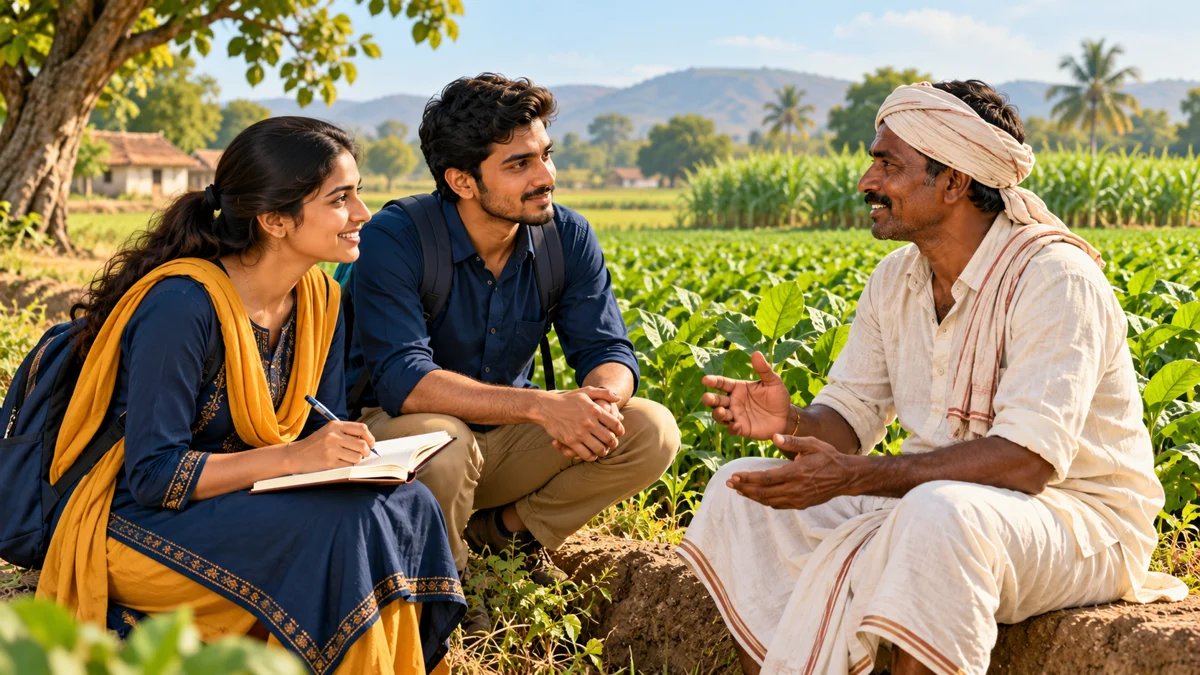
A field diary is most useful when it helps you explain what you observed, how you learned it and what you still need to check. For agriculture students preparing for RAWE, a few careful notes each day can become a stronger learning record than a long report assembled from memory at the end.
ICAR's 2024–25 agricultural education report places RAWE within practical learning under Student READY. Your own university decides the current assignments, schedule and assessment. Use this guide as a personal organising method alongside its instructions.
Before the first visit: know your assignment
Ask your supervisor for the required format, submission dates, field arrangements and expectations for individual and group work. Keep those instructions in the front of your notebook. A useful personal template must not replace the assessed university format.
Choose one manageable learning goal for the visit. Instead of “understand the whole farm”, try “understand how the farmer organises one crop operation”. You can ask more focused questions and identify the information you did not obtain.
Prepare a short introduction explaining who you are, why you are visiting and what you hope to record. Agree on what can be photographed or shared before opening a camera.
A simple field-diary structure
| Field | What to write |
|---|---|
| Visit and purpose | Date, permitted location detail, activity and the question you wanted to understand. |
| Observation | What you directly saw or measured. Include the method and units where relevant. |
| Conversation | What a participant explained, clearly labelled as their account rather than your measurement. |
| Interpretation | Your explanation, what supports it and what alternative explanation is possible. |
| Follow-up | A question for the supervisor, a source to read or an observation to repeat. |
For example, “the farmer reported a higher harvest last season” is different from “I measured a yield increase”. Preserving that difference makes the record more credible. If you missed a measurement, record the gap rather than reconstructing a number later.
Finish the entry while the visit is fresh. Keep original notes and put corrections in a dated follow-up so you can explain how your understanding changed.
Ask about decisions, not only facts
A conversation becomes more informative when it explores the reasoning behind an activity. You might ask what options were considered, what made the decision difficult and what the farmer would change next time.
- Start with open questions and allow the person to describe the situation in their own terms.
- Clarify unfamiliar terms instead of silently replacing them with textbook language.
- Ask permission before recording quotations, photographs or personal details.
- Bring technical uncertainties back to your supervisor; avoid presenting yourself as an adviser beyond your competence.
When you write the report, separate direct quotations, your paraphrases and your own interpretation. An anonymised example can still need care if its location and context identify the person.
Build a small portfolio that shows your learning
At the end of each week, select one question you understand better and one you still cannot answer. Choose a small set of permitted evidence: a diagram you made, a table of observations or a short explanation of your method.
- State the question. What were you trying to understand?
- Show the evidence. Where did it come from, and what was your contribution?
- Explain the limitation. What can the evidence support, and what cannot it establish?
- Describe the next step. What would you investigate or practise differently?
A report with honest limits demonstrates more learning than an impressive-looking set of unsupported conclusions. Keep public portfolio material separate from documents submitted privately to your university.
Quick questions
Kya yahi university ka compulsory RAWE format hai?
Nahi. Yeh personal organising template hai. Apne department ka official format aur supervisor ki instructions follow karein.
Field visit mein data nahi mila toh kya likhein?
Jo dekha aur jo nahi mil saka, dono clearly note karein. Missing information ko invented numbers se fill na karein; supervisor se follow-up discuss karein.
Portfolio mein kitne examples hone chahiye?
Quality aur assessment requirements ke hisaab se select karein. Is guide mein koi compulsory project count prescribe nahi kiya gaya hai.
Continue learning
Reference
ICAR Annual Report 2024–25: Agricultural Education. Background reference checked on 19 October 2026. Templates and examples above are MeriShiksha's editorial suggestions.
